Where the Sheep Go to Die
The last Journey
The rain had been falling for three days without reprieve, not the soft Irish mist that Maeve had grown accustomed to in her forty-seven years, but a relentless hammering that turned the bog roads to rivers and made the turf smoke reluctantly in the grate. She stood at the kitchen window of the cottage, her palm flat against the glass, feeling the cold seep through, and watched the blackface sheep scattered across the lower field, their wool darkened to the colour of pewter, their heads bent against the wind that came rolling off the Ocean.
Her father had kept sheep on this same land, and his father before him, back through generations she could trace only by the photographs in the parlour and the stories that had been handed down like heirlooms, worn smooth with retelling. But in all those years, in all those stories, no one had ever spoken of where the sheep went to die. You never found them, not unless they'd been hit by a car on the coast road or taken by dogs. They simply disappeared, as though they knew something the living didn't, as though they possessed an instinct that guided them away from the places where they'd grazed and lambed and sheltered.
Maeve had been thinking about this more often lately. Since her mother's death the previous winter, the question had taken root in her mind with a persistence she couldn't quite explain. Her mother had died in the cottage's small bedroom, the same room where she'd been born eighty-three years earlier, with Maeve holding her hand and the district nurse checking her pulse every quarter hour. There had been no mystery to it, no disappearance. Just the gradual diminishment of breath, the cooling of skin, the terrible finality of presence becoming absence, whilst Maeve's own hand had grown numb with gripping.
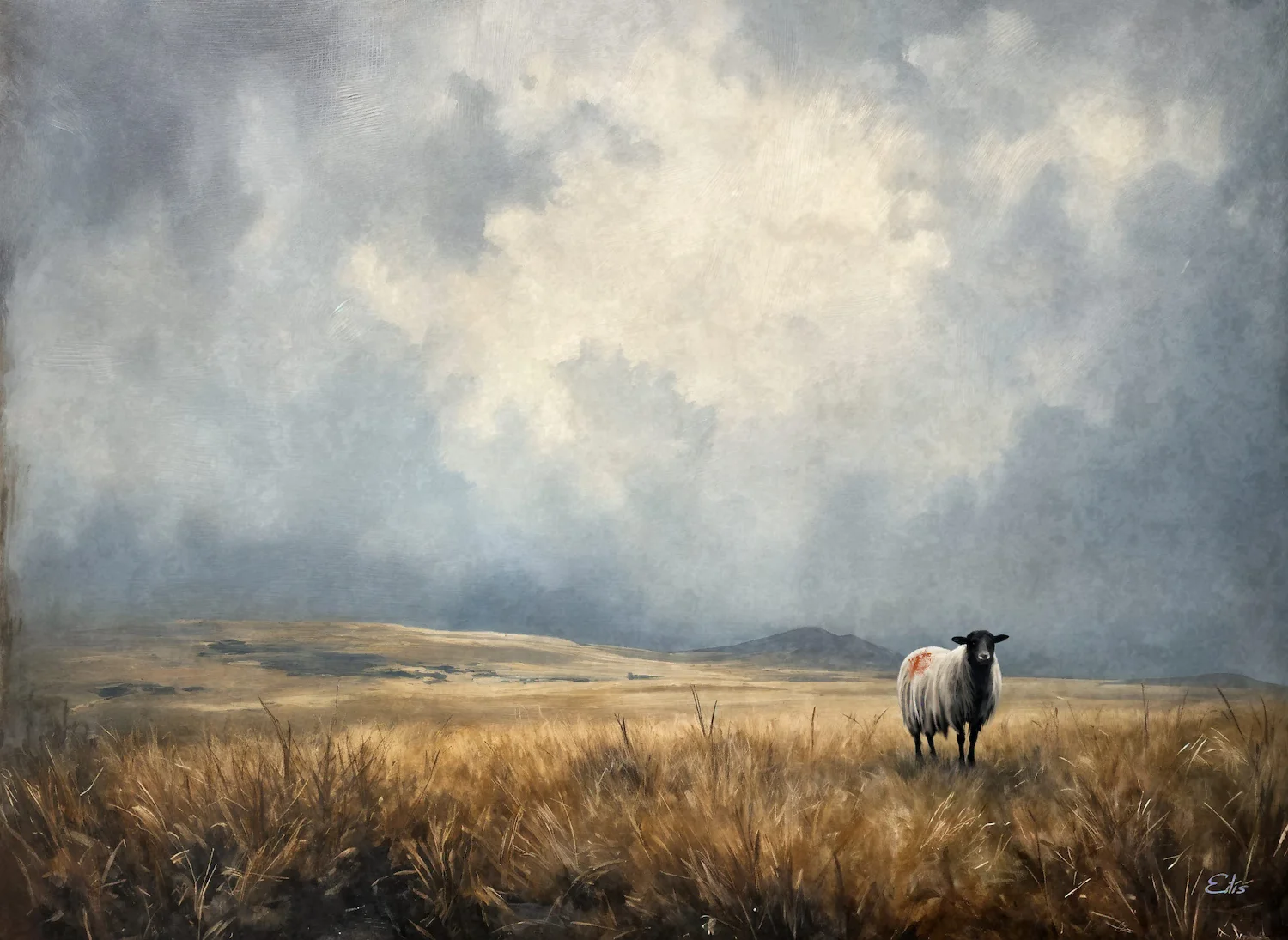
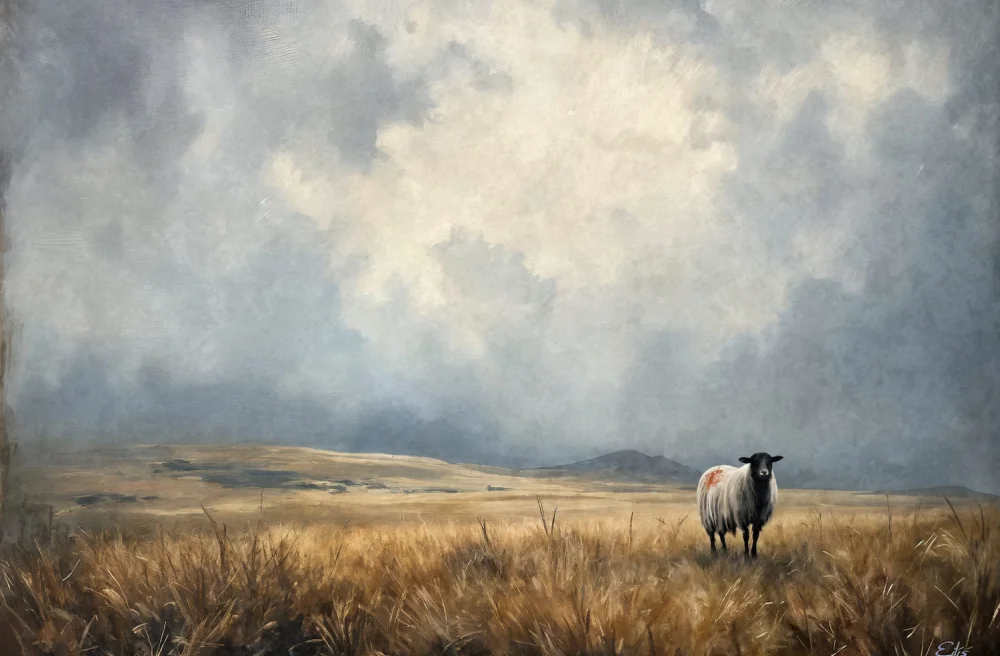
The sheep in the field shifted, moving as a loose constellation rather than a flock, each animal maintaining its own small radius of solitude. One ewe stood apart from the others, closer to the stone wall that marked the boundary with the Faherty land. Even from this distance, Maeve could see that something was wrong with her gait, a stiffness in the hindquarters, a reluctance in her movements.
She pulled on her wellies and the waxed jacket that had been her father's, still smelling faintly of lanolin and tobacco, and went out into the weather. The rain struck her face with the force of small accusations, and she bent her head as she crossed the yard, her boots sucking in the mud.
The ewe didn't move as Maeve approached, though her ears flicked back, registering the human presence. Up close, Maeve could see the clouding in one eye, the way the animal's breathing came shallow and rapid, the slight tremor that ran through her flanks. This was Fifteen – the number sprayed in red across her wool last spring had faded to pink, then to a ghost, but Maeve had marked her in the farm ledger five years ago, when she was a lamb herself, all legs and foolish vitality.
"Easy now," Maeve said, though she knew the sound of her voice would mean nothing to the sheep beyond the identification of a human approach. She ran her hand along Fifteen's spine, feeling the knobs of vertebrae too prominent beneath the wool, the heat of fever, the terrible fragility of a creature that had, until recently, been all stubborn endurance.
She should call Declan Moran, the vet, but she already knew what he would say. The kindest thing would be to put her down, here in the field, quick and clean. But Maeve found herself hesitating, her hand still resting on the ewe's back, feeling the small movements of breath and blood beneath the wool.
Instead, she did something she couldn't quite justify, even to herself. She opened the gate to the upper field, the one that ran up the slope towards Cillín na Leanaí, the old children's burial ground that was marked only by a ring of stones and the folk memory of unbaptised infants laid to rest in unconsecrated ground. The land there was rough and rocky, more heather than grass, with outcroppings of limestone that broke through the thin soil like the bones of the earth itself.
"Go on, then," she said to Fifteen, though she didn't push her, didn't try to drive her through the gate. She simply stood there, holding it open, rain streaming down her face, mixing with something that might have been tears or might have been just more water.
The ewe stood for a long moment, head lowered, sides heaving. Then, slowly, with a deliberation that seemed almost purposeful, she walked through the gate. Not quickly, not with any eagerness, but with a kind of recognition, as though this was exactly what she'd been waiting for, permission to go wherever it was that sheep went when their time came.
Maeve watched her climb the slope, her pace steady despite the stiffness, despite the rain, despite the wind that tore at her wool and made the heather flatten and rise in waves. She didn't look back. She simply climbed, growing smaller against the grey-green expanse, until she crested the rise and disappeared beyond it, into the landscape that stretched away towards the Twelve Bens, towards the vast indifference of the mountains.
Three weeks later, on a morning when the rain had finally stopped and the sun was attempting to break through the cloud cover, casting fingers of light across the bog, Maeve walked up to Cillín na Leanaí. She told herself she was checking the fences, looking for breaks where sheep might get through to the road, but she knew she was lying.
The ring of stones was as it had always been, lichen-covered and ancient, marking out a space that felt separate from the ordinary world. And there, just beyond the stones, nestled in a hollow where the heather grew thick, she found what remained of Fifteen.
The ewe lay on her side, legs extended stiffly, her neck stretched as though reaching towards something Maeve couldn't see. The rain had washed her wool clean, and in death, she looked diminished, unburdened. Already the crows had been at her, and the foxes too, no doubt, beginning the work of returning her to the earth. But her body was intact enough that Maeve could still recognise her, could still make out the ghost of the faded spray mark on her wool, could still remember her as a lamb, all reckless joy and determination to live.
Maeve stood for a long time, looking down at the body, feeling the wind on her face, gentler now than it had been for days. Around her, the bog stretched away in all directions, the land her family had worked for generations, the land that had taken so much from them and given so much back. In the distance, she could see the other sheep, scattered across the lower fields, moving slowly through their own small geographies of survival.
She thought about her father, who had collapsed whilst stacking turf and had been found by a neighbour, already gone, his hands still curved around the handle of his slean. She thought about all the creatures who had lived and died on this land, the sheep and cattle and dogs and people, and how they'd all, in their way, returned to it.
Kneeling beside Fifteen's body, Maeve placed her hand on the ewe's wool one last time. It was cold now, damp from the rain, but still soft, still carrying that particular scent of lanolin and grass and the bog itself.
"Good girl," she said quietly, though whether she was speaking to the sheep or to herself or to the land itself, she couldn't have said.
She stood and turned back towards the cottage, leaving the body where it lay. The crows would finish their work, and the foxes, and eventually the weather itself, and in a season or two there would be nothing left but bones, and then not even that, just the heather growing thick and the stones marking out their eternal circle, and the sheep continuing their slow migrations across the fields, carrying within them that ancient knowledge of where to go, when the time came, to die with something like dignity, something like peace.
That evening, as Maeve sat by the fire with a cup of tea cooling in her hands, she thought about how the question had changed. It was no longer, "Where do sheep go to die?" but rather, "How do they know?" What instinct guided them away from the flock, away from the familiar fields, towards the high places, the thin places where the boundary between this world and whatever came after seemed more permeable?
She thought about Fifteen making that slow climb up the slope, how purposeful she'd seemed despite her weakness, how she'd known, somehow, that this was right. And she wondered if, when her own time came, she would have that same certainty, that same instinctive knowledge of where she needed to be.
Outside, the rain had started again, lighter now, a proper Irish mist that softened the edges of things and made the boundaries between land and sky uncertain. In the morning, she would go back to the work of farming, to checking fences and counting sheep and all the ordinary tasks that had filled her days since she was old enough to walk these fields. But tonight, she simply sat and listened to the rain and thought about the sheep in the upper field, near the old burial ground, and how even in death, there was a kind of grace, a kind of homecoming.
The fire crackled, sending up sparks that died before reaching the chimney top. Maeve set down her tea and pulled her mother's shawl more tightly around her shoulders, feeling the weight of it, the warmth, the accumulated comfort of years of use. Tomorrow, she would call Declan Moran after all, and ask him to come and check the rest of the flock, make sure there were no others carrying fever or foot rot or any of the hundred other ailments that could take a sheep down. For now, though, she would simply sit and remember Fifteen as a lamb, her heedless exuberance and appetite for living, and be grateful for the mystery of it, the not-knowing that left room for grace.
Outside in the darkness, somewhere on the slopes above the cottage, the other sheep grazed on, indifferent to human questions, carrying within them their ancient knowledge, their instinctive understanding of the proper time and place for endings. And the rain fell, and the wind blew, and the bog breathed quietly in the darkness, absorbing all of it – the life and the death, the questions and the silence, the sheep and the woman and the land itself, all of it bound together in a pattern too vast and too intimate to ever fully comprehend.
Maeve closed her eyes and listened to the rain, and in the sound of it, in the steady rhythm of water meeting earth, she thought she heard something like an answer, though she couldn't have put it into words, not then, not ever. Some truths, she understood, were not meant to be spoken. They could only be witnessed, honoured, and then released back into the landscape that had given them birth, to be discovered again by whoever came after, walking these same fields, asking these same questions, seeking comfort in the ancient rhythms of living and dying that the sheep, in their wordless wisdom, had understood all along.