
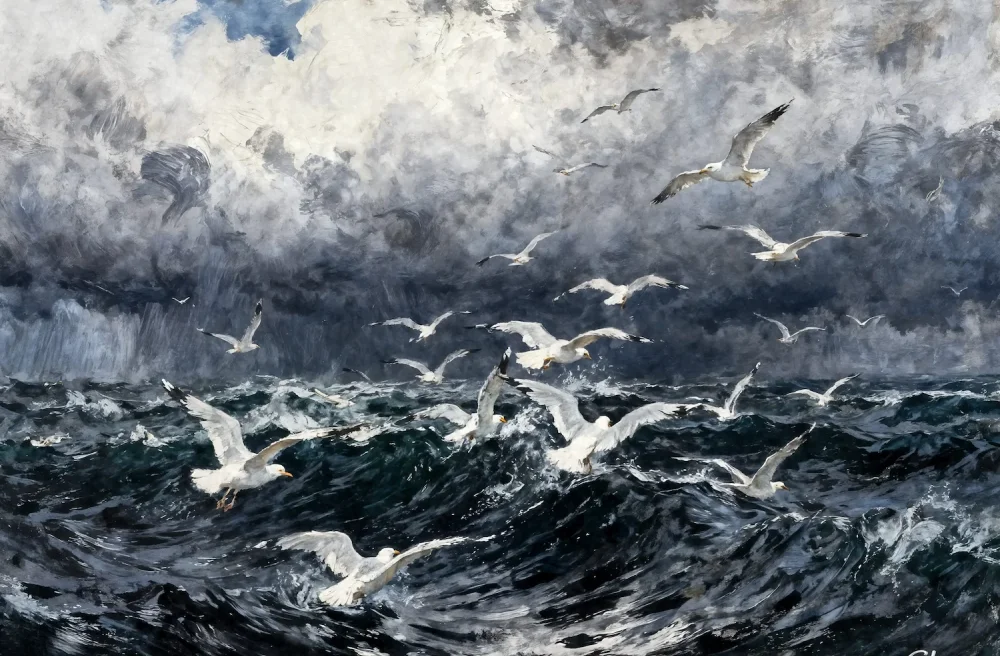
Flashing in the Storm
Seagulls
The man stood at the harbour's edge, watching the gulls work the turbulent water. His shoulders curved inward against the wind, not from cold but from something more persistent—a weariness that had settled into his bones over years of perpetual motion. The birds swooped low, their wings cutting white arcs against the darkening sky, and he recognised in their trajectory something of his own life's pattern: the constant descent towards sustenance, the brief touch of what might nourish, then the lifting away again before anything could take root.
He had come to the coast seeking what he always sought and never found. Peace, perhaps. Or simply a pause in the relentless forward momentum that had defined his existence since he could remember. His fingers traced the weathered railing, the wood smooth and grey from decades of salt and touch, and he thought about the gulls' nests—wherever they might be. Did they return to the same crevice in the cliff face each evening? Did they recognise home when they saw it?
The question seemed almost absurd when applied to his own life. Three cities in five years. Relationships that burned bright and brief, leaving him each time with the taste of ash and the certainty that he had somehow been the one to strike the match. His colleagues spoke of him with a certain admiration—brilliant, they said, innovative, tireless—but there was always a qualifier in their eyes, an unspoken recognition that something fundamental was missing. He moved through their lives like weather, leaving an impression but never staying long enough to be truly known.
A gull plunged towards the waves, its body tensing in that instant before contact. The man leaned forward, his breath catching as he watched the bird's beak strike the surface, seizing something silver and struggling. There was violence in it, and efficiency, and a kind of grace born from necessity. The bird rose again, prize clenched in its bill, wings labouring against the weight. He wondered if it felt triumph, or merely relief at having survived another moment in the endless cycle of hunger and satiation.
The storm was building from the west. He could see it in the way the clouds massed and darkened, in the increasing agitation of the water. Most of the other people along the harbour had already retreated to the cafés and shops that lined the waterfront, their lit windows promising warmth and the comfortable illusion of permanence. But he remained, because this—this churning boundary between elements—felt more honest than those interior spaces where people pretended their lives were settled things.
His phone buzzed in his pocket. He knew without looking that it would be Sarah. She had been calling for three days now, her messages evolving from confusion to hurt to anger, and finally to a kind of resigned understanding that he recognised too well. He had seen it in other faces, this gradual comprehension that he was not someone who could be held, not because he was cruel or indifferent, but because some essential part of him refused to land.
The gulls wheeled overhead, their cries sharp and plaintive against the wind. He tilted his head back to watch them, feeling the first drops of rain on his upturned face. They should be seeking shelter, he thought. They should be returning to wherever it was they went when the weather turned vicious. But they stayed, riding the thermals, diving and rising in what looked like play but was surely something more purposeful.
He thought about his mother, dead now five years, who had once told him he was like his father—unable to be still, unable to be content. She had said it without rancour, stating it as simple fact, the way one might identify a birthmark or a tendency towards allergies. His father had left when he was seven, chasing some opportunity that had glittered on a distant horizon. The man understood now, with the clarity that middle age occasionally granted, that his father had not been running towards anything at all. He had simply been incapable of remaining.
The storm struck with sudden force. Rain came in diagonal sheets, and the wind rose to a pitch that made the moored boats strain against their lines. His tweed jacket grew heavy with water, clinging to his shoulders, his hair streaming water into his eyes. He should go. He knew he should go. But he watched the gulls instead, and saw how they turned into the wind, how they used the very force that should have destroyed them to lift higher, to flash white against the bruised sky like signals or warnings or prayers.
One bird flew lower than the others, so close he could see the black gleaming of its eye, the way its head cocked to regard him. For a moment—absurd, impossible—he felt recognised. As though the creature knew him for what he was: another being who skimmed surfaces, who fed on what could be grasped quickly, who could not or would not settle even when every instinct screamed for rest.
The gull cried out, a sound that might have been challenge or kinship, then banked sharply and rejoined its fellows in their storm dance. The man watched until his eyes burned from the salt spray, watched until he could no longer distinguish individual birds from the collective flash and wheel of their bodies against the darkening clouds.
When he finally turned away, his legs stiff from standing so long, he found he was not heading back towards his car, towards the anonymous hotel room he had rented for a week that would inevitably become only three days. Instead, he walked along the harbour wall, into the teeth of the weather, his footsteps keeping time with the rhythm of the waves. There was nowhere he was going, no destination that would prove more genuine than this moment of moving through the storm.
Perhaps, he thought, this was the only honesty he would ever know: not the calm he claimed to desire, but this constant state of motion, this flashing in the tempest. Perhaps the gulls knew something humans spent their lives trying to unlearn—that some creatures were made not for nesting but for flight, not for the great calm of the sea but for the perpetual work of staying airborne.
The realisation brought neither peace nor despair. It simply was, like the rain on his face, like the wind that pushed him forward and held him back in the same moment. He thought of Sarah, of all the others, of the life he might have built if he had been differently made. But the thinking was abstract now, like considering a path visible on a map but impossibly distant from where his feet actually stood.
Ahead, the harbour curved out of sight. Behind, the lights of the town blurred into golden smears through the rain. And somewhere in between, a man walked alone, while overhead the gulls continued their necessary and beautiful work of surviving the storm, never landing, always in flight, catching what brightness they could in the spaces between the clouds.