Lost Connection
The abandoned Booth
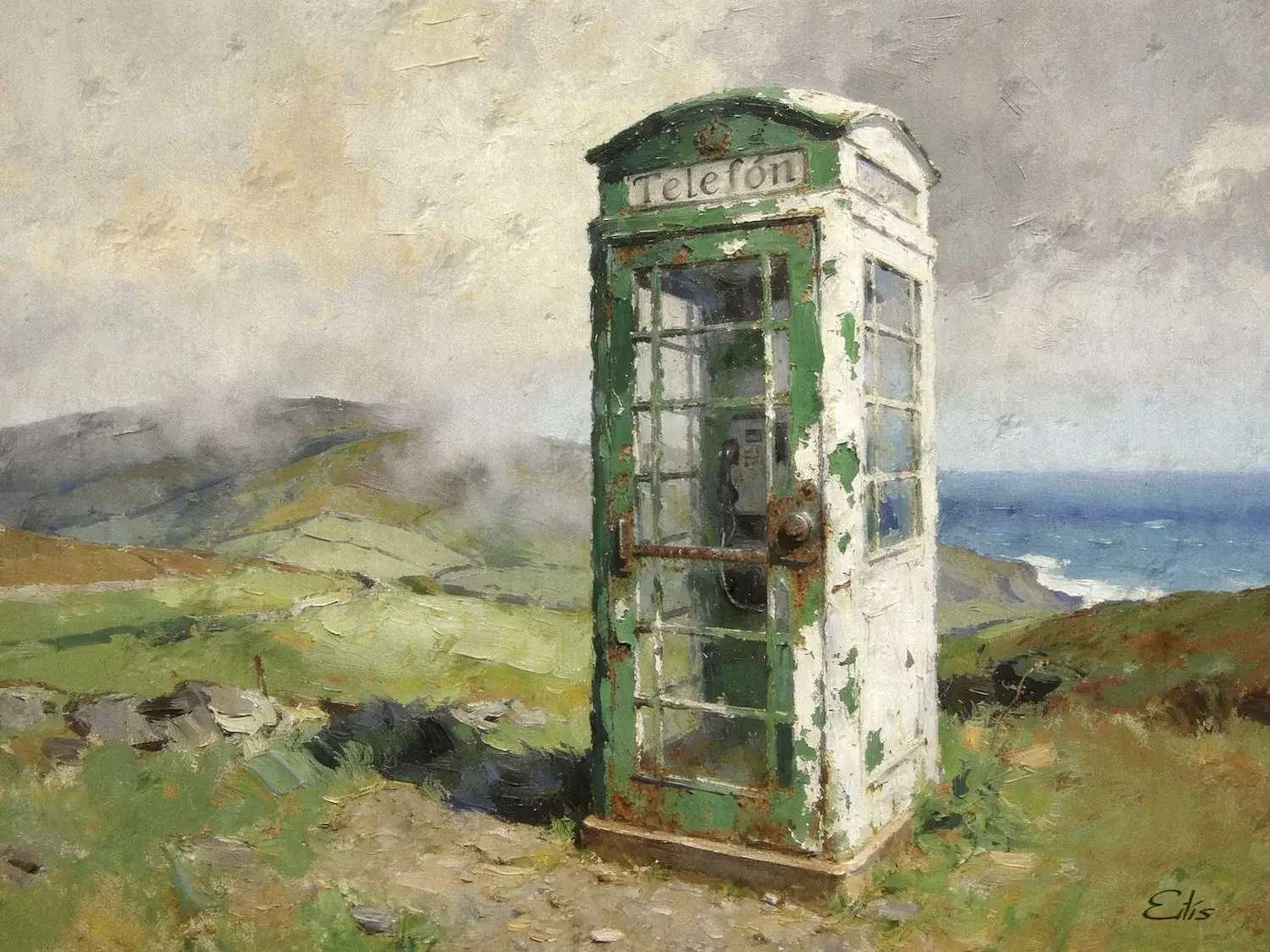
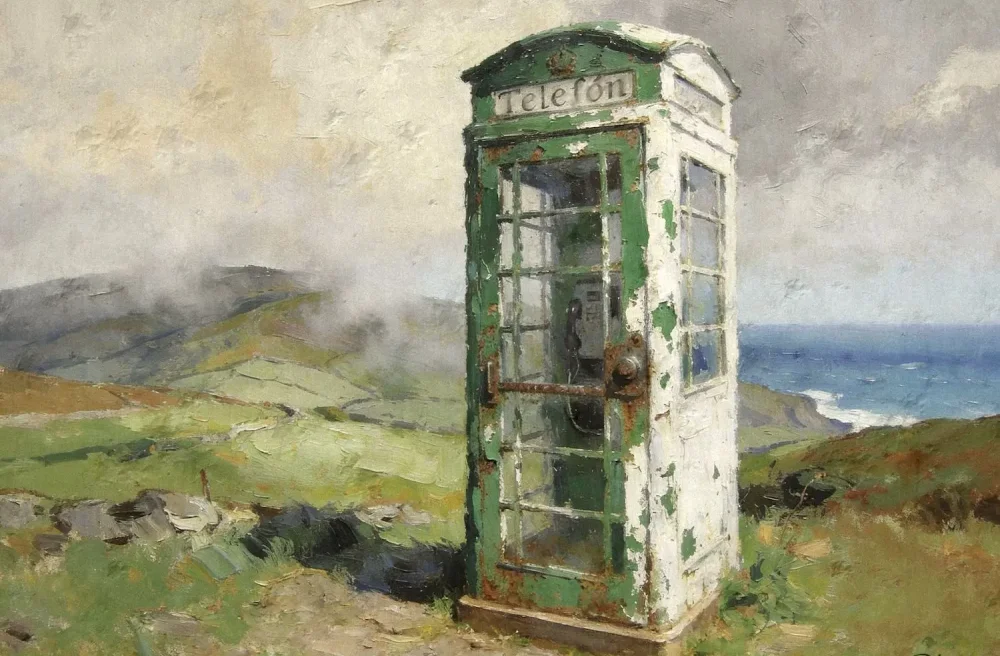
The phone box stood where it had always stood, on the brow of the hill where the land fell away in folds of yellow gorse and grey stone towards the Atlantic. Its green paint had surrendered to the weather in patches, peeling back to reveal the white primer beneath, and in places the white had given way too, exposing the metal skeleton that held the structure upright against the wind. The word "Telefón" remained legible across the top panel, though rust had begun its work on the letters, bleeding through the enamel like an old stain resurfacing.
Máire had stopped noticing it years ago. She passed it twice daily on her walks, once in the morning when the light was still hesitant, and again in the evening when it lengthened across the headland. The phone box had become part of the landscape, as unremarkable as the stone walls that stitched the fields together or the sheep that grazed between them, their faces blackened by the breed, by something older than memory.
But today she stopped.
She couldn't have said what made her pause, what quality in the air or the light or her own internal weather had shifted. Her hand, she noticed, had reached for the door before her mind had quite caught up with the impulse. The metal was cold beneath her palm, gritty with salt carried up from the sea. She pulled, and the door gave with a metallic groan that seemed too loud in the stillness.
Inside, the booth smelled of rust and damp and something indefinable—the accumulated essence of disuse, perhaps, or abandonment. The phone itself hung at an angle, its cord twisted into a spiral that had lost all memory of its original form. The receiver was missing its mouthpiece, leaving only a hollow where voices had once travelled through copper and air to reach someone, somewhere, who mattered.
She stood in the narrow space and felt the walls close around her shoulders. Through the scratched panes, the landscape remained where it had always been: the hill sloping down to the cliffs, the sea beyond, restless even on calm days, working at the rocks with a patience that would outlast everything human. She had grown up with this view. It had been the constant backdrop to her childhood, her adolescence, the slow years of her twenties and thirties when she'd stayed on after others had left, after the village had begun its gradual emptying.
Her fingers found the dial. She traced the numbers, still visible despite the grime: one through nine, and the zero at the bottom. She remembered, suddenly and with startling clarity, standing here at seventeen, feeding coins into the slot, dialling the number of a boy in Galway who'd promised to call but hadn't. She remembered the weight of the receiver against her ear, the way she'd pressed herself into the corner to escape the wind that found every gap in the frame. She remembered the precise quality of her disappointment when the phone had rung and rung and rung into emptiness.
The memory arrived without sentiment, a bare fact retrieved from storage. She had become, over the years, skilled at this kind of remembering—emotional archaeology conducted without feeling, the careful excavation of experience from which all affect had leached away.
There had been other calls from this booth. She reconstructed them now with the same clinical detachment: calling her mother at hospital in Cork, the nurse's voice careful and practised as it delivered news that could not be softened. Calling her brother in Boston to tell him not to bother coming home for the funeral, that it would be over before he could arrange the flights, that she would manage. Calling the solicitor about the farm, about the papers that needed signing, about the life that had narrowed down to a series of administrative tasks that could be completed alone.
The last time she'd used this phone—she calculated backwards—must have been five years ago, perhaps six. Before mobile signals had finally reached even this remote pocket of the coast, before the last excuse for the booth's existence had evaporated. She tried to remember what that final call had been, but the memory refused to surface. Mundane, probably. The shop in the village ordering something, or the doctor's surgery confirming an appointment. Nothing worth preserving.
She lifted the dead receiver to her ear anyway. The plastic was cold, shaped by decades of other hands, other ears, other voices that had poured their urgency or longing or simple daily business into this vessel. She could hear nothing, of course. No dial tone, no static, not even the sound of her own breathing amplified back to her. Just silence, absolute and final.
What struck her—and she registered this with something approaching surprise—was not sadness but a kind of vertiginous awareness of severance. The line was cut. Whatever had connected this box to the world beyond the headland had been severed, the cables dug up or simply left to corrode where they lay buried in the earth. The infrastructure of connection had been abandoned, deemed obsolete, surplus to requirements.
She thought of the other calls that had been made from here, the ones she hadn't witnessed. Voices she'd never heard speaking words she'd never know to people whose names she'd never learn. Entire conversations that had existed briefly in the space between this booth and some distant receiver, then dissolved completely, leaving no trace. All those words, all that feeling, all that need to reach across distance—where did it go when the line went dead?
Her own life, she understood, had followed a similar trajectory. The connections she'd maintained had attenuated over time, stretched thin by geography and circumstance and her own failure—or was it refusal?—to sustain them. Her brother called at Christmas, stilted conversations full of long pauses in which neither of them could think what to say next. The neighbours nodded as they passed on the road but rarely stopped. The women she'd known at school had married, moved away, built lives in Dublin or Cork or further, lives that had diverged from hers so completely that when she encountered them on rare visits to town, they struggled to find common ground beyond the weather and vague pleasantries about time passing.
She had not minded, or had thought she hadn't minded. She had her routines, her walks, her garden, the sheep she kept more from habit than necessity. She read in the evenings, listened to the radio, sometimes drove to Clifden for shopping or to sit in the library where at least there were other people nearby, even if she didn't speak to them. She had convinced herself this was enough, this life pared down to its essential components, stripped of complication and demand.
But standing in this defunct phone box, receiver pressed to her ear, she felt something shift in her chest. Not grief, exactly. Something quieter, more pervasive. A recognition of accumulated loss that she had been carrying without acknowledging its weight.
The glass was clouded with salt and scratches, reducing the view to impressions: grey sky, green hill, blue sea, all bleeding into each other at the edges. She watched a bird—a crow, she thought, though she couldn't be certain—trace a diagonal across her limited field of vision, its flight casual, purposeful, connected to the landscape in a way she suddenly felt she was not.
When had the disconnection happened? She couldn't identify a precise moment. It had been gradual, she supposed, the way erosion worked on the cliffs below—imperceptible from day to day, obvious only in retrospect when you noticed how much had been carried away.
She replaced the receiver carefully, though there was no reason for care. The phone was broken, had been broken for years. No one would use it again. Eventually, she supposed, someone from the council would arrange for its removal, one last administrative task to be completed. Or perhaps they'd leave it, a relic too insignificant to warrant the effort of dismantling, left to collapse slowly under its own weight and the weather's patient work.
She pushed the door open and stepped back into the wind. It hit her face with familiar force, carrying the smell of salt and seaweed and rain that hadn't yet arrived but would, soon, before dark. The landscape arranged itself around her: hill, sea, sky, the stone walls dividing nothing from nothing, the sheep scattered across the slopes like punctuation in a language she'd forgotten how to read.
Her cottage was visible from here, a quarter mile down the track, smoke rising from the chimney where she'd left the fire banked. She would walk back now, put the kettle on, sit in her chair by the window as the afternoon dimmed into evening. Tomorrow she would walk this route again, and the day after, and the day after that. The phone box would be here, silent and rusting, and she would pass it, and the sea would work at the cliffs, and the wind would strip another layer of paint from the metal frame.
Nothing would change, and she would manage.
But as she turned to go, she found herself looking back at the booth. Its green paint glowed dully in the flat light, a colour that belonged to a different era, to a time when connection had required this kind of waystation, these fixed points of contact scattered across the landscape like cairns marking a route that was no longer travelled.
She wondered if anyone else ever stopped here. If anyone else remembered making calls from this box, standing in this exact spot, feeding coins into the slot, willing the ringing to stop and a voice to answer. She wondered if any of those people ever thought about the calls they'd made, the words they'd spoken into the receiver, the ways they'd tried to bridge distance with nothing but voice and copper wire.
She wondered if disconnection was something that happened to you or something you chose, so gradually that you didn't notice until it was complete.
The question lodged itself somewhere behind her ribs, uncomfortable, resistant to the dismissal she tried to apply. She started walking, her boots finding their familiar rhythm on the track. The cottage waited, and the kettle, and the chair, and the evening that would arrive whether she was ready for it or not.
Behind her, the phone box stood against the sky. The wind moved through its broken panes, a low sound like breathing, or like the absence of breathing. The receiver swayed slightly on its cord, twisting in the draught, conducting a conversation with nothing, the way it would continue to do long after she was gone, long after anyone who remembered its purpose had vanished, long after the reason for its existence had been forgotten completely.
She did not look back again. But she carried the image with her as she walked: the green paint peeling, the word "Telefón" fading into rust, the empty booth standing sentinel over a view that never changed and was always changing, witness to a kind of connection that had once seemed vital and now seemed quaint, a technology of intimacy rendered obsolete by time and progress and the steady erosion of the need to reach out across distance to touch someone who might, if they answered, make you feel less alone.
The wind pushed at her back, hurrying her along the track towards home. She let it guide her, this force that had been pushing at her all her life, that had worn the paint from the phone box and would, in time, wear everything else away too—the booth, the cottage, the walls, the hill itself, everything except the sea and the wind and the sky, which would remain, indifferent and eternal, long after the last connection had been severed and there was no one left to notice the silence.