All I want for 'Xmas...
The Gift of Memory
Each year, when the familiar question echoes through the air—"What would you like for Christmas?"—I hear others respond with their catalogues of wants: the latest gadgets, jewellery that catches the light, books with pristine spines waiting to be cracked open. Yet for me, the most precious gift transcends the material world entirely. It exists nowhere but in the chambers of memory, and I am its sole custodian.
What I long for is the Christmas of my childhood—those luminous weeks in Alassio when my parents wove an enchanted tapestry around me, thread by patient thread, until I was cocooned in something I can only name as grace.
I was eight, perhaps nine, the year I remember most vividly. We had travelled down from Milano, leaving behind the fog and the everyday, repetitive tasks. Mamma sat in the passenger seat, turning occasionally to smile at me in the back, where I pressed my nose against the cold window and watched the landscape transform from the grey industrial sprawl of the north to the gentler, salt-aired beauty of the Ligurian coast.
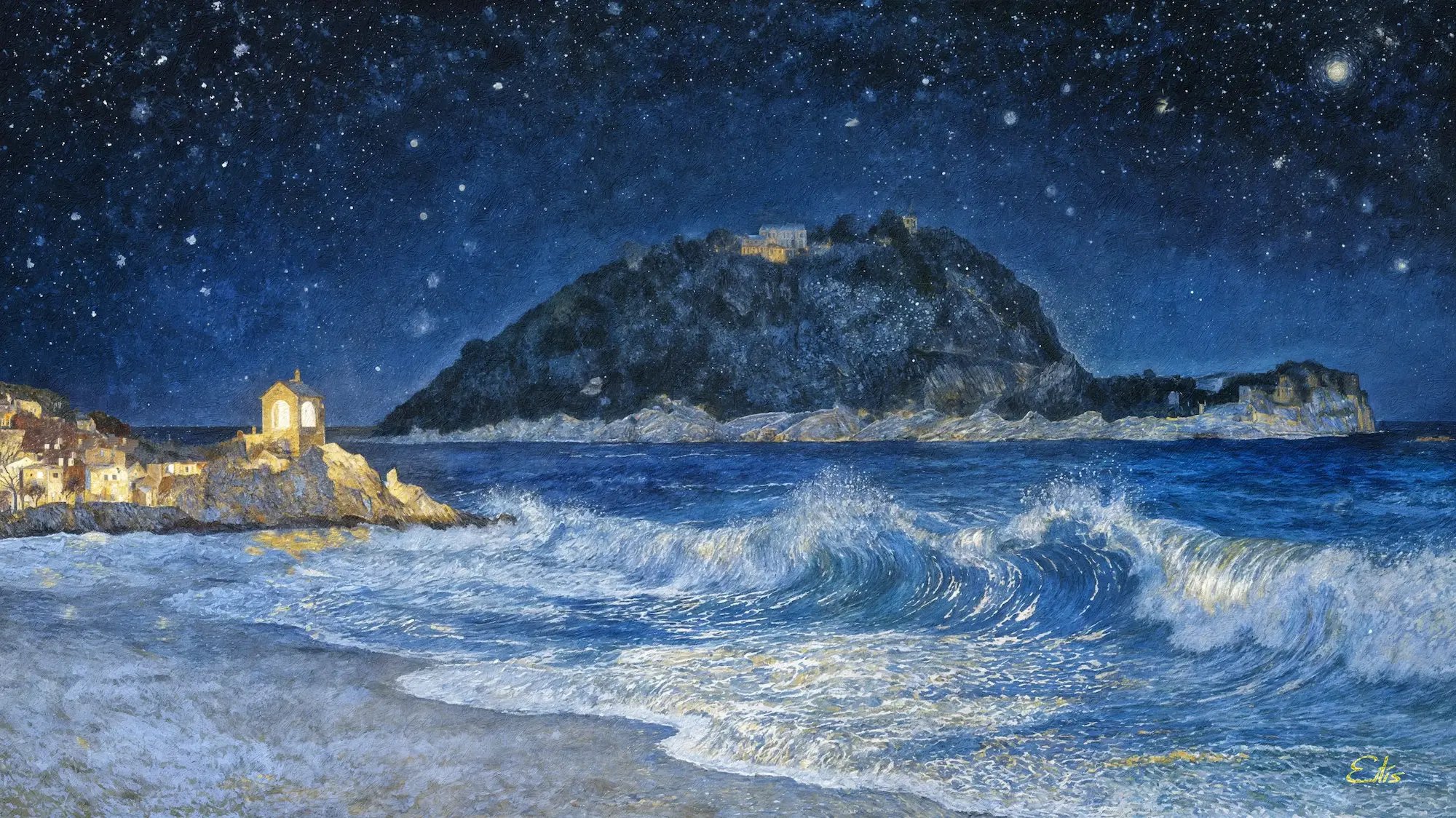
Our apartment sat on the lungomare, close enough to the sea that on stormy nights—and there were many that winter—I could hear the waves hurling themselves against the shore with a violence that thrilled and frightened me in equal measure.
Mamma spent her days in the kitchen, and from where I sat at the dining table with my colouring books, I could watch her work. She moved with the quiet efficiency of someone who has performed these rituals a thousand times: rolling dough for the canestrelli, those delicate butter biscuits dusted with icing sugar; stirring the pot of cioccolata calda that sent ribbons of chocolate and cinnamon into the air; candying orange peel in sugar syrup until the strips turned translucent as stained glass.
The apartment filled with an olfactory symphony—cinnamon and clove, vanilla and hazelnut, the bright citric notes of tangerine and blood orange, the deep bass tones of dark chocolate and espresso.
Sometimes she would call me over to help. I would stand on a chair beside her, my small hands dusted with flour, learning to cut the biscuits into stars and hearts and Christmas trees. She never scolded when I ate more dough than I shaped, or when I got flour on the floor and sugar in my hair. Instead, she would dab a bit of icing on my nose and laugh—a sound like bells, clear and bright.
"You're making memories," she would say, as though this were the true purpose of our baking, more important than the biscuits themselves.
Papa spent the mornings reading in his armchair by the window, a book open on his lap, though I often caught him gazing out at the tempestuous sea instead, lost in some private contemplation. In the afternoons, when the light began to fail, he would close his book and turn his attention to me.
We played Tombola and he let me win just often enough to keep me keen without making it obvious. He read to me from his childhood books, his voice rising and falling with the drama of the stories, doing different voices for each character until I was breathless with laughter.
We decorated the tree together, an artificial fir that stood waiting in its cardboard box each December like some patient relic of forests I would never know. Though no one spoke it aloud—and perhaps this silence was itself a kind of speech—I understood that something in my parents recoiled from the idea of a living thing sacrificed. They imagined, I think, a fir tree cut and dying slowly in a centrally heated room, its needles falling like small surrenders, only to be dragged to the kerb when we returned to the city. And so this was our compromise, practically eternal, reusable each Christmas, untethered from guilt.
Before LED garlands existed, there were the old electric luminaries—chains of small multicoloured bulbs that my father would test each year with the concentrated expression of a man performing minor surgery. I watched his fingers work with a patience that seemed to alter the very texture of time, substituting burnt-out lights until the moment arrived to test his repairs. My mother's hand rested lightly on my shoulder—I was to keep absolutely at a distance from the socket—and then, if fortune held, that small everyday magic occurred: our tree illuminating the darkest evenings of winter, each bulb a tiny coloured sun against the encroaching dark outside our windows.
There existed a precise order to the dressing of the tree, a sequence of steps my father narrated quietly, as though passing down something more essential than mere decoration. First the garlands, threaded from summit to base, the little lights positioned at varying heights so that no branch remained in shadow. Then the finial placed at the top—this done before the baubles were hung, because afterwards it would prove impossible to crown the tree without risking those fragile glass ornaments that seemed to hold their breath in their nests of tissue paper.
No plastic then. Only blown glass, some pieces swirled with silver and gold that caught the light like captured frost. The tree filled itself gradually with these multicoloured globes, each suspended by the thinnest of hooks, perpetually ready to detach and roll across the floor, shattering into constellations of glittering fragments that would embed themselves in the carpet for weeks afterwards. I was permitted to hang them on the lower branches, those within reach of my child's height, and I held each sphere between my palms with the careful attention one reserves for something alive—for something that might, with a moment's carelessness, cease to exist entirely.
We arranged the Nativity scene on a low table in a corner, its surface gradually transformed into mountainous terrain through our collaborative efforts. Old newspaper sheets crumpled and mounded, then draped with what we called rock-paper—brown wrapping printed with patches of earth-colour, grey-green, ochre and terracotta. The paper folded itself under our hands into hollows and reliefs, a topography born entirely of imagination.
Then came the little houses of cork and corrugated cardboard, their roofs thick with plaster-snow that never melted, the bridge spanning a torrent we fashioned from a silver garland. The watercourse ended in a small lake—my mother's handbag mirror, its surface reflecting the ceiling and transforming it into sky. At the heart of everything sat the stable, its floor scattered with straw and moss that still carried the faint scent of summer.
The village prepared, there came at last the moment I loved most: the placement of figures. I lifted each one from its box with a sense of reunion that even then felt disproportionate to their painted plaster reality. Pino the cobbler—yes, we had given the more beloved characters actual names—I stationed before his house, forever bent over his workbench. Giuseppina, the washerwoman at the torrent's edge, her hands arrested mid-gesture above water that would never flow. Tonio the woodcutter emerging from a painted forest, surrounded by his eternal heap of logs.
But it was the shepherds who commanded my attention, even more than the angels with their great plaster wings. I arranged them in attitudes of astonishment before the stable, adjusting the angle of a head, the position of a staff, conferring upon them through these small movements something approaching genuine wonder. The sheep grazed the moss—which to them, I imagined, must taste of eternity itself. The little dogs remained alert, their painted eyes watchful for straying ewes. I placed last the ox and donkey, their presence a comfort that transcended their stillness.
Evening arrived as it always did, drawing the winter dark around our house like a familiar coat, and with it came the moment to illuminate the enormous star on the top of the stable. I watched my father's hand move towards the switch, and then light flooded the scene—light falling upon Mary and Joseph, upon the Infant in his manger with his small plaster arms spread wide, his face turned upwards as if listening to a celestial music just beyond the range of human hearing.
Standing there in the dimming room, the tree's coloured lights reflected in the window glass, I felt the particular ache of happiness that barely knows itself to be temporary, that understands even in the moment of its fullness that it is passing, that it belongs already to memory, to the country of things that can never be recovered except through the inadequate vessel of words.
"There," Mamma said, adjusting the angel's wings one final time. "Now it's Christmas."
Outside, the weather turned. The sky pressed down like pewter, and the sea grew wild, throwing itself against the breakwater with a fury that sent spray high into the air. The wind howled against the big windows overlooking the sea with a sound like grief. Rain lashed the glass, blurring the world beyond into an impressionist smear of grey and white.
But inside, we existed in our own climate—a microclimate of warmth and light and love so abundant it seemed to thicken the very air. We ate our Christmas Eve dinner by candlelight: sea bream oven-cooked in a crust of sea salt and mashed potatoes, followed by Panettone, whilst outside the storm raged on, forgotten.
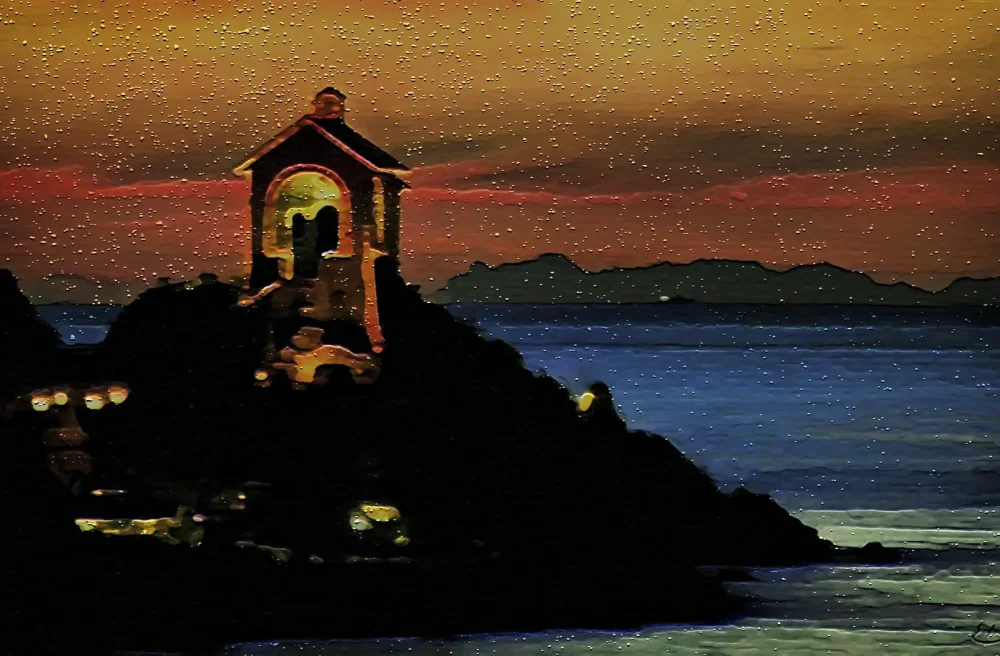
After Mass at the little church in the old fishermen's neighbourhood of the town—where the friar's sermon was mercifully brief and the congregation sang Adeste Fideles in wavering voices—we returned home to find that the Holy Child had visited in our absence.
Presents sat beneath the tree, wrapped in colourful papers and gleaming ribbons. The gifts were proof of a covenant I had kept: a whole year spent trying to behave well—with family, with school friends, even with unrelated, occasional acquaintances—had earned me the right to receive exactly what I had requested in my letter to the Holy Child. The discovery that my wishes had been granted, that my good behaviour had been witnessed and rewarded, filled me with pure, uncomplicated joy.
But the gifts I remember most clearly are not the ones that came wrapped in paper.
There was the gift of Papa's presence—solid, reliable, a fixed point around which my small world revolved. When he carried me to bed, my head against his shoulder, I felt the steady rhythm of his heartbeat and knew myself to be safe in a way that went beyond the merely physical. He was my shelter, my certainty in an uncertain world.
There was the gift of Mamma's tenderness—the way she tucked the blankets around me with a precision that spoke of love made manifest. The way she kissed my forehead and whispered, "Sogni d'oro, tesoro mio"—golden dreams, my treasure.
There was the gift of belonging, of being seen and known and cherished exactly as I was. I did not have to earn their love or perform for their affection. It simply was, as constant as the tide, as necessary as breath.
Looking back now, across the years that have accumulated like snowfall, I see that what I experienced in that small apartment in Alassio was nothing less than the architecture of perfect love. My parents constructed it carefully, stone by stone, moment by moment, until I existed within a cathedral of their making—a sacred space where I was both worshipper and worshipped, where every gesture was a prayer and every word a benediction.
I took it for granted, as children do. I assumed that this warmth would last for ever, that the walls they had built around me were permanent, immutable. I did not understand that love, however vast, is still subject to the laws of time and entropy. I did not know that one day I would stand outside those walls, unable to return, with nothing but memory to warm me.
And now, when people ask me what I want for Christmas, I smile and shake my head. What I want cannot be purchased or wrapped or placed beneath a tree. What I want is lost to time, preserved only in the amber of memory.
I want to be eight years old again, standing on a chair in a kitchen that smells of cinnamon and chocolate, my hands dusted with flour, whilst my mother laughs and dabs icing on my nose. I want to fall asleep to the sound of my father's voice reading Pinocchio, his presence a bulwark against the storm outside. I want to wake on Christmas morning to find the world transformed by something greater than snow or presents—transformed by the simple, miraculous fact of being loved so completely, so unreservedly, that I took it as my birthright.
That is my Christmas wish: not to have those days back—I know better than to wish for the impossible—but to have known, whilst I was living them, how precious they were. To have understood that these moments were not infinite, that the gift of my parents' love was not a permanent installation but a temporary exhibition, and that I should have looked more carefully, paid closer attention, committed every detail to memory with the diligence of a scholar studying a sacred text.
If I could go back, I would linger longer over breakfast. I would watch more carefully as Mamma stirred the pot of cioccolata calda, memorising the exact motion of her wrist. I would listen more attentively to Papa's stories, noting the precise timbre of his voice, the way his eyes crinkled when he smiled. I would press my nose harder against the window, breathe more deeply the scent of cinnamon and vanilla, hold their hands more tightly when they reached for mine.
I would have understood that love is not a given but a gift, and like all gifts, it can be taken away.
But perhaps this is the gift I can give myself now: the acknowledgement that once, I was held in the palm of perfect love. Once, I knew what it was to be completely safe, completely cherished, completely home.
And though I cannot return to that time, though those days are lost to me except in the palace of memory, they shaped me nonetheless. They taught me what love looks like when it is given freely, without condition or reservation. They showed me that home is not a place but a feeling—the feeling of being seen and known and loved exactly as you are.
So when Christmas comes this year, I will light a candle. I will play Adeste Fideles on the old record player. I will bake canestrelli using Mamma's recipe, the one written in her careful hand on a card yellowed with age and spotted with flour. I will remember.
And in remembering, I will unwrap the only gift that truly matters: the knowledge that once, long ago, in a small apartment overlooking a winter sea, I was given everything.