
The House at the Edge
The Beach House
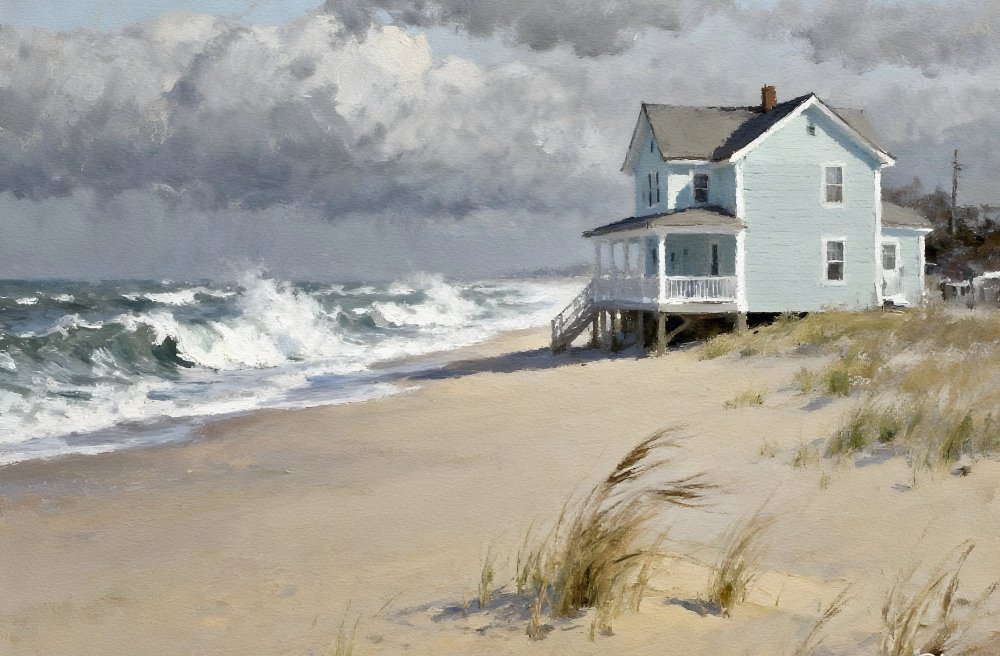
The house stands where it has no right to stand—perched on wooden stilts that sink into sand the colour of old bone, facing an ocean that wants to reclaim what was never truly surrendered. Mara watches it from the dune grass, her fingers working unconsciously at the frayed hem of her jacket, a habit she thought she'd abandoned years ago but which returns now with the salt air and the particular quality of light that slants through storm clouds gathering like bruises across the sky.
She has been standing here for twenty minutes, perhaps longer. Time dilates in this landscape, stretches and contracts with the rhythm of waves that throw themselves against the shore with a violence that feels almost personal. The house is smaller than she remembers, though memory is an unreliable architect. Its pale blue paint—once the colour of robins' eggs, her mother used to say—has weathered to something more complex, streaked with grey and rust where the sea air has worked its patient alchemy on the nails beneath.
The porch extends from the front like a gesture of welcome or surrender, its railings crooked now, listing slightly towards the water as though the house itself is leaning into its inevitable fate. Mara's throat tightens. She swallows against it, feels the small bones of her neck shift beneath skin that has seen too much sun in recent months, too many hotel rooms in coastal towns where she told herself she was working, researching, doing anything but circling closer to this particular shore.
Behind her, the hire car ticks as its engine cools. She left it parked at an angle that suggests haste or indecision, the driver's door not quite closed. She should go back and shut it properly. Instead, she takes three steps forward, her trainers sinking into sand that gives way beneath her weight with a softness that feels like acquiescence. The beach grasses whisper around her ankles—spartina and sea oats, names her father taught her when teaching was still possible, before language became the first thing the illness took from him.
The waves are enormous today, green-grey and muscled with intent, their crests blown backwards by wind that tastes of distance and salt and something mineral she cannot name. They crash with a sound that obliterates thought, then drag backwards across the sand with a hiss that sounds almost like breathing. The rhythm of it works its way into her chest, her lungs adjusting their cadence to match until she is breathing with the sea, her body remembering something her mind has tried to forget.
She was seven when they first came here. No—eight. The correction matters, though she cannot say why. Eight years old and already learning to catalogue things, to note and record as though precision might protect her from the wild disorder of feeling. Her father had driven them down in the old Volvo that smelled of pipe tobacco and newsprint, her mother quiet in the passenger seat, her silence the particular quality of silence that meant decisions had been made without consultation, without the democratic process their household supposedly honoured.
The house had belonged to her father's uncle, a man Mara met only twice and remembered primarily as a collection of gestures—gnarled hands that moved in precise arcs when he spoke about the stars, a habit of pausing mid-sentence as though listening to something no one else could hear. He had left the house to Mara's father with the kind of casualness that suggested he understood its true value had nothing to do with property prices or rental potential. It was a place for disappearing into, for becoming small enough that the world's noise couldn't find you.
They had spent three summers here before everything changed. Mara remembers those months in fragments—the screech of gulls at dawn, the particular grain of the wooden floor beneath her bare feet, the way her father's voice carried from the porch where he sat in the evenings reading aloud from books she was too young to understand but loved anyway for the sound of the words, the rhythm of them. Her mother had painted at an easel set up in the room that faced south, her hands moving with a certainty they lacked in the rest of her life, capturing the light on canvas with colours that seemed to hold weather inside them.
The house is empty now. Mara knows this in the way one knows things without needing confirmation—some quality of its stillness announces itself across the distance, speaks of rooms where no kettle boils, no footsteps sound on the stairs. Her father sold it years ago. Or rather, it was sold on his behalf, the legalities managed by solicitors whose letters came on heavy paper that felt like an accusation in her hands. She had been twenty-three, living in London, pretending her absence was about ambition rather than cowardice.
She hadn't known it had been sold back into the family until three weeks ago, when the phone call came from a cousin she barely remembered, a woman named Siobhan who spoke with the careful enunciation of someone delivering news they know will detonate. Her father's younger brother—the one who had moved to Canada and made a fortune in something involving patents and technology—had bought it two years ago. He'd meant it as a gift, Siobhan said, a way of preserving something. But he'd died last winter, suddenly, and now it fell to Mara. The inheritor of what had already been inherited, a chain of custody for a place that belonged more to memory than to any deed or document.
The wind shifts, bringing rain with it—not yet falling but present in the air, a dampness that settles on Mara's skin like a second surface. She shivers, though it isn't cold. Her body registers things before her mind can process them, a phenomenon she has become more aware of since starting therapy six months ago. Dr. Okonkwo is fond of asking where she feels things, as though emotions are housed in specific organs rather than flooding through the entire system. Mara has learned to answer anyway, to point to her sternum or her gut, to describe the quality of tension in her shoulders as though mapping a geography of unspoken distress.
She wonders what Dr. Okonkwo would make of this pilgrimage, this return to the site of before. They have spoken about her father, of course—it would be impossible not to, given how thoroughly his absence has structured her adult life. But they haven't spoken about this place, this particular configuration of wood and glass and failing paint. Mara realises she has been protecting it, keeping it separate, as though speaking of it might dissolve its specificity into mere symbol.
A gull shrieks overhead, and she flinches, her whole body contracting around the sound. When she opens her eyes—she hadn't realised she'd closed them—the house seems closer, though she hasn't moved. The porch steps are visible now in detail that shouldn't be possible at this distance: four weathered treads, the bottom one split lengthwise, a darkness in the gap that might be water damage or shadow or some small creature's home.
She thinks suddenly of her father's hands. Not as they became—curled and useless, fingers that forgot their purpose—but as they were. Long-fingered and careful, always in motion. He had a habit of drumming them against his thigh when he was thinking, a rhythm she associated with safety, with problems being worked through towards solutions. Those hands had built the railing on that porch, replaced the boards when the first winter storms proved the uncle's construction less than sound. She had sat on the steps watching him work, had handed him nails from the canvas pouch he wore slung across his chest like a messenger bag.
"Measure twice, cut once," he'd said, and she had written it down in the notebook she carried everywhere that summer, treating his offhand comment as though it were scripture. She had been ten then, maybe eleven, old enough to sense that time was not infinite, that the span of summers stretched ahead with an ending she couldn't see but could feel approaching like weather on the horizon.
The last summer they came here, she was thirteen. Her father had already begun to lose words—not in any dramatic fashion, but quietly, like keys slipping from a pocket. He would pause mid-sentence, his face taking on a particular expression of frustration mixed with something like bewilderment, as though his own mind had become a room in which he was no longer entirely certain of the furniture's placement. Her mother had grown quieter, her silences now weighted differently, no longer comfortable but watchful, waiting.
Mara hadn't understood, then. Or she had understood in the way children understand adult distress—obliquely, interpreting its manifestations without grasping its source. She had spent that summer reading on the beach, constructing elaborate fortresses from driftwood and kelp, avoiding the house where tension gathered in corners like cobwebs. She had been angry, she remembers now. Angry at the change in atmosphere, at the way her parents moved around each other with unnatural care, at the end of the easy rhythm that had characterised previous summers.
She hadn't known it would be the last one. Neither, she suspects, had they. There is a particular cruelty in that kind of ignorance, in not knowing how to catalogue the final iterations of things. The last time her father read to her. The last time she saw him swim in the ocean, his strokes strong and sure, his body still entirely his own. The last time the three of them sat on the porch in the evening, watching light drain from the sky while her mother's hand rested on her father's shoulder and everything was still, briefly, intact.
Mara's eyes are wet. She reaches up and touches her cheek, surprised by the tears, though she shouldn't be. Grief is like this, she has learned—patient, willing to wait years for the right conjunction of circumstances, the precise quality of light and salt air and memory that will undo carefully constructed defences.
She walks forward now without deciding to, her feet carrying her across sand that shifts beneath her weight, then onto firmer ground where beach grass gives way to the narrow path that leads to the steps. The wood is grey with age and exposure, soft in places where rot has begun its work. She tests each step before committing her weight to it, an automatic caution that has nothing to do with conscious thought.
The porch boards creak beneath her. The sound is familiar in a way that bypasses language, speaks directly to some older part of her brain where memory is stored as sensation rather than narrative. She stops in front of the door—painted the same blue as the house's exterior, its surface crazed with fine cracks—and realises she has no key. Siobhan had mentioned posting one, but Mara had left London three days after that phone call, driven by an urgency she couldn't articulate, and hadn't stayed to collect her post.
She tries the handle anyway. It turns.
The door swings inward on hinges that shriek with disuse, and she is met with the smell of closed spaces and time passed—dust and old wood and, beneath that, something else. Something that might be lavender, might be her mother's preferred washing powder, might be nothing but synaesthesia produced by a mind too overwhelmed to process sensory information without conflating it with memory.
The interior is dim after the bright grey light outside. Mara's eyes adjust slowly, shapes resolving from shadow. The front room is smaller than she remembers but configured exactly as it was—the sofa still positioned beneath the window that faces the sea, its cushions collapsed into themselves like lungs that have forgotten to breathe. The fireplace on the north wall, its mouth dark and cold. Her mother's easel still stands in the corner by the southern window, draped with a sheet that has gone grey with dust.
Mara's breath catches. She had expected emptiness, sterility, the anonymous quality of a space cleared of personal history. But this—this is preservation that borders on a shrine. She moves towards the easel, her hand reaching out before caution can intervene. The sheet is cotton, she realises as her fingers find its edge. Good quality. Someone has cared for this, protected it from the worst of the dust and damp.
She pulls the sheet away slowly. It comes free in a single movement, folding onto itself, and there is the easel exactly as it stood—the wooden legs still splashed with paint in a dozen colours, the shelf that holds brushes long dried to uselessness, the clips that held canvas waiting empty.
Behind her, the floorboards creak. Mara spins, her heart suddenly enormous in her chest, her breath shallow. A figure stands in the doorway—backlit by the grey light outside, features obscured. For one impossible moment, she thinks she thinks it might be him, her father returned, time collapsed and death undone by the simple fact of her needing him.
"I'm sorry." The voice is female, uncertain. "I didn't mean to startle you. I saw the door was open."Mara's heart slows fractionally. The woman steps forward, revealing herself to be perhaps seventy, with white hair pulled back in a loose knot and a weathered face that suggests a life spent outdoors. She wears a waxed jacket over corduroy trousers, boots that have tracked sand onto the floor.
"I'm Margaret," she says. "I live in the cottage up the beach. Your uncle—your father's brother—asked me to look after the place. Keep it aired, check the roof after storms." She pauses, her eyes moving past Mara to the easel. "You must be Mara. Siobhan rang to say you might be coming."
Mara nods, not trusting her voice. Margaret's gaze is kind but assessing, taking in Mara's reddened eyes, her white-knuckled grip on the sheet she still holds.
"I've kept things as they were," Margaret continues. "Your uncle said that was what your father would have wanted. Before he—" She stops herself, recalibrates. "There was a period, apparently, when your father's mind was clearer. He wrote letters. Your uncle showed me one, asked me to do what I could to maintain the house as it had been."
The information settles over Mara like a weight, like hands on her shoulders pressing down. Her father had remembered, then. Had thought of this place in those brief windows of clarity that punctuated his decline. Had wanted it preserved. She doesn't know what to do with this knowledge, where to store it.
"I'll leave you," Margaret says, misreading Mara's silence for a desire for privacy. "But I'm just up the beach if you need anything. The water's been turned back on, and there's electricity. The heating works, though you'll want to let it run for a while before it's properly warm." She moves towards the door, then pauses. "He loved this place. Your father. You could see it in the way he moved through it, like the rooms were made to fit him exactly."
Then she is gone, and Mara is alone with the easel and the collapsed sofa and the smell of time passing. She sits down on the floor—not a conscious choice but a collapse, her legs simply refusing to hold her weight any longer. The boards are cool beneath her, slightly gritty with sand that has worked its way into cracks and crevices despite Margaret's evident care.
She sits there for a long time, her back against the wall, watching light change in the window as the sun moves behind clouds that promise rain but don't yet deliver. Outside, the ocean continues its work of erosion and persistence, waves throwing themselves at the shore with a rhythm that has outlasted everything—her father's decline, her mother's retreat into silence, Mara's own flight to a city where anonymity could be mistaken for freedom.
Eventually, she stands. Her legs have gone stiff from sitting on the cold floor, her back aching where it pressed against the wall. She moves through the house slowly, opening doors onto rooms that exhale stale air and memory. The kitchen with its old range cooker and the table where they ate meals together, rain drumming on the roof. The bathroom with its claw-foot tub and the window that looks out onto dune grass. The stairs that climb to the first floor, each step announcing her presence with creaks and groans.
There are three bedrooms upstairs. Her parents’ spare and simple, the bed still made with blankets tucked with hospital precision. The guest room that no guest ever used, containing only a single bed and a chest of drawers. And her room—the smallest, tucked under the eaves at the back of the house, its window facing not the ocean but the land that stretches away towards roads and towns and the life she constructed in opposition to this place.
The room is exactly as she left it. The single bed with its quilt patterned in squares of blue and white. The bookshelf she made from bricks and planks, still holding the books she read that last summer—Austen and Brontë and Ursula K. Le Guin, their spines cracked from multiple readings. The desk beneath the window where she wrote in journals she later burned, convinced her teenage angst was too embarrassing to preserve.
She sits on the bed and it accepts her weight with the same creak of springs she remembers, a sound that once meant safety, meant home. The tears come properly now, not just dampness on her cheeks but wracking sobs that shake her whole frame, pull sounds from her throat she didn't know she could make. She cries for her father, for the man who built porch railings and read poetry aloud and lost himself by degrees until there was nothing left but a body that breathed and ate and existed without recognition. She cries for her mother, who retreated after into a silence that proved permanent, who died five years later of an aneurysm that the doctors said was quick but which Mara suspects began the moment her husband first failed to remember her name. She cries for herself—the girl who sat on porch steps, the teenager who fled this place, the woman who has spent a decade constructing a life in careful opposition to feeling, to the overwhelming tide of grief that threatened to drown her if she stopped moving long enough to let it catch up.
When the crying stops, she feels emptied, scraped clean. The light in the window has changed again—the rain has begun, soft at first but building to a steady drumming on the roof that sounds like accompaniment, like permission. She lies back on the bed, pulls the quilt over herself despite still wearing her jacket and trainers, and lets the sound of rain fill the spaces where thought should be.
She sleeps, or something like it. When she wakes, the room is darker and the rain has intensified, driven against the windows by wind that makes the house creak and settle in ways that sound almost like conversation. She feels disoriented, untethered from time. It might be evening or afternoon or some hour between night and day where normal rules don't apply.
She goes downstairs slowly, one hand on the railing her father built. In the kitchen, she finds that Margaret has left supplies—tea bags and milk in the fridge that hums with an enthusiasm that suggests recent repair, bread that is only slightly stale, eggs, and butter. There is also a note, Margaret's handwriting careful and precise: "Shops are three miles north if you need more. Take care."
Mara makes tea, the ritual of it—kettle boiling, cup warming, tea steeping—grounding her back in the ordinary. She takes the cup to the front room and stands at the window, watching the ocean rage against the shore. The waves are enormous now, driven by the storm, their crests white and wild. They explode against the beach with force that sends spray ten feet into the air, salt water and sand, and the fragments of shells reduced to powder.
The house shudders with each impact, a vibration that travels up through the stilts and into the floorboards beneath her feet. She should be frightened, perhaps. The house feels fragile against the storm's fury, a human construction foolish in its defiance of nature's intent. But she isn't frightened. Instead, she feels a strange exhilaration, a wildness answering wildness. The storm doesn't care about her grief or her guilt or the careful ways she has learned to portion out feeling in doses small enough to be manageable. It simply is, vast and indifferent and completely itself.
She drinks her tea standing at the window, watching the light drain from the sky until the ocean is just sound, invisible beyond the glass. When the cup is empty, she finds blankets in the chest beneath the stairs—wool, slightly musty but clean—and carries them to her room. She undresses slowly, her clothes salt-stiffened and damp, and climbs into the bed that held the child she was.
The storm continues through the night, rain and wind and waves combining into a single vast noise that should prevent sleep but somehow doesn't. Mara lies in the darkness, listening, and somewhere in the gap between waking and dreaming, she hears her father's voice. Not memory exactly, but something closer to presence. He is reading aloud, the words indistinct but the rhythm perfect, rising and falling like breath, like waves, like all the things that persist despite everything.
When morning comes, the storm has passed. Mara wakes to silence so complete it feels like a physical substance, like something she has to push through to reach consciousness. She lies still for a long moment, uncertain where she is, her body registering information—the particular quality of light, the smell of salt and old wood, the distant sound of gulls—before her mind catches up.
She rises and goes to the window. The ocean is calm now, its surface silvered by early light, as though last night's fury was imagined. The beach is littered with debris—kelp and driftwood, and things less identifiable, offerings the sea has made to the land. The sky is clear, pale blue deepening to something richer at the horizon.
She dresses and goes downstairs. Makes more tea, eats bread toasted in a pan on the stove because the toaster has long since given up its function. Then she puts on her jacket and goes outside.
The air is so clean it almost hurts to breathe, scrubbed pure by rain and wind. Everything looks sharper, edges more defined. Mara walks down the steps and onto the beach, her feet sinking into sand that is heavy with water, compacted by the storm's weight.
She walks south, away from where Margaret's cottage must be, wanting solitude that is more than just being alone in the house. The beach curves ahead of her, disappearing around a headland she remembers climbing as a child, the rocks there black and slippery with algae, alive with tide pools that held entire worlds in miniature.
She walks for an hour, maybe more, stopping occasionally to examine what the storm has brought—a piece of net worn soft by time and water, a bottle so frosted by sand it is nearly opaque, a plank of wood that might have been part of a boat or a house or something else entirely. She collects nothing, simply looks and moves on, a witness to what the ocean has chosen to surrender.
When she turns back, the house is visible from a distance, small and improbable against the grey sky. The sight of it does something to her chest, a tightening that isn't quite pain. She understands now what her uncle meant, why he bought it back. Not as an investment or even truly as a gift, but as an act of preservation. Some places hold more than just structure and space. They hold versions of people who no longer exist, moments that can't be recovered but can be honoured by maintaining the setting in which they occurred.
She thinks of Dr. Okonkwo's question about where she feels things. The answer, she realises, is here. Not in her body but in this place, this configuration of wood and glass and memory built at the edge of what land can claim. Her grief lives here, but also something else. The person she was before the loss taught her to be careful. The girl who collected shells and built driftwood fortresses and believed summers were infinite. She isn't that girl anymore—that version of herself is as gone as her father, as her mother, as everything that house once held. But she is made of her, continuous with her in ways that can't be severed no matter how far she runs.
The walk back takes less time than the walk out, or maybe she is simply more certain of the path. When she reaches the house, she stands for a moment at the base of the steps, looking up at it. The paint is peeling badly on the seaward side, the roof has lost shingles, and the whole structure lists slightly towards the water as though tired of resisting. It won't last forever. Maybe not even much longer. The ocean will claim it eventually, pull it down board by board until nothing remains but the stilts like ribs jutting from sand.
But not yet. For now, it stands.
Mara climbs the steps and goes inside. The house receives her, its rooms no longer strange. She spends the day in small tasks—opening windows to air out the mustiness, wiping dust from surfaces, sorting through kitchen drawers and cupboards. She finds her mother's painting supplies in a box in the cupboard beneath the stairs—tubes of paint hardened but still bearing the colours they once held, brushes stiff with old pigment, sketchbooks filled with studies of light on water, preliminary drawings for works that may or may not have been completed.
She carries the box to the front room and sets it beside the easel. She isn't a painter—has no talent for it, no training. But she takes out one of the sketchbooks and sits on the sofa and looks at her mother's drawings. The lines are confident, economical, capturing the essence of things—the curve of a wave, the angle of light through clouds, the particular grace of a gull in flight. Her mother had been good at this, Mara realises. Not just competent but genuinely skilled. She wonders what else she didn't know about her mother, what other parts of her were hidden behind the careful surface she presented.
That night, Mara lights the fire in the fireplace, feeding it kindling and then larger pieces until flames catch and hold. She sits on the floor in front of it, wrapped in blankets, watching the way the light moves on the walls. The wood pops and hisses, releasing the salt it has absorbed from years of exposure. The sound is companionable, almost conversational.
She stays for a week. Each day follows a pattern that establishes itself without intention—waking early, making tea, walking the beach, returning to the house to read or sort through her parents' belongings or simply sit and watch the ocean. Margaret visits twice, bringing fresh supplies and asking no questions, seeming to understand that Mara needs this time without having to explain it.
On the seventh day, Mara takes her father's toolbox from the shed out back—miraculously still there, still containing tools wrapped against rust—and sets about repairing what she can. She replaces the broken step, her movements careful and methodical, measuring twice before cutting. She tightens screws on the porch railing, shores up a section that has come loose. She isn't skilled at this, doesn't have her father's natural facility with tools and wood, but she is careful and patient and willing to try multiple times until something holds.
By evening, her hands are blistered and her back aches, but the repairs are done. She stands back and assesses her work. It isn't perfect—the new board on the step is slightly different in colour, and will need time and weather to match the others. But it is sound. It will hold.
That night, she calls Siobhan. The conversation is brief—Mara explains she has been at the house, asks about practicalities. Siobhan says the house is hers to do with as she wishes. Sell it, rent it, keep it. The choice is Mara's.
After they hang up, Mara sits on the porch in the darkness, listening to the ocean. She thinks about futures, possibilities. She could return to London, put the house on the market, let it become someone else's concern. Or she could come back—not to live, perhaps, but regularly. Keep it maintained, keep it alive. Make it a place she returns to rather than one she fled from.
The ocean offers no advice, simply continues its eternal work of arrival and recession. Mara sits until the cold drives her inside, until her body insists on warmth and rest. But before she goes in, she places one hand on the railing she has just repaired, feels the wood solid beneath her palm.
In the morning, she will leave. Drive north to Dublin, catch her flight, return to the life she has built—the flat, the job, the carefully constructed routines. But she will come back. Perhaps in a month, perhaps longer. But she will come back.
She understands now what her uncle knew, what her father wanted preserved. Not the house itself, exactly, but what it represents. A place where time bent differently, where summers stretched like hours and the only sound that mattered was the ocean's voice. Where three people once sat on a porch and watched light drain from the sky and were, for that moment, exactly where they needed to be.
The house will fall eventually. Everything does. But until then, it will stand at the edge of land and sea, holding its ground against the waves that want to reclaim it. And Mara will return to witness its standing, to maintain what can be maintained, to sit once more in the rooms where the girl she was believed that love and summer and the sound of her father's voice reading poetry were permanent things, fixtures as reliable as the tide.
She sleeps that night without dreams, or with dreams so gentle they leave no trace. When she wakes for the last time in her childhood bed, the light through the window is gold and clean, and somewhere below, the ocean is beginning its daily work of erosion and persistence, patient as grief, relentless as memory, vast as the space between who we were and who we have become.