The Land of Heart's Desire
A homage to Yeats
There is a particular quality to the light that falls over the west of Ireland in the dying hour of the day. It does not simply illuminate; it transforms. It reaches across the bog and the broken stone wall and the thatched roof still holding its ground against centuries of Atlantic weather, and it turns the ordinary into something that aches.
This painting begins there. In that ache.
I have been living with Yeats for a long time.
Not in any formal, scholarly sense — I mean the way you live with a poet when their lines have gotten into you early and refused to leave. When you find yourself, thirty years later, standing at the edge of a bog in the last hour of daylight, and the words surface unbidden: where nobody gets old and godly and grave. Where the land itself seems to be offering you something you cannot name and cannot quite refuse.
The Land of Heart's Desire was written in 1894, when Yeats was twenty-eight, unhappily in love, and already fluent in the language of longing. The play is set on Bealtaine — the first of May, that ancient threshold between the cold half of the year and the warm, the night when the boundary between this world and the other grows thin and permeable. A young bride, Mary Bruin, is lured away from the hearth by a fairy child, drawn toward the freedom of the otherworld. She goes. The family left behind can only watch.
I read the play again one autumn evening, sitting at my kitchen table with the window open and the smell of turf smoke coming in off the fields. And I felt, as I have always felt reading Yeats at dusk in the west of Ireland, that the play was not describing something imagined. It was describing something observed. The bog at evening, the low sun burning itself out on the horizon, the birds going somewhere you cannot follow — these things do not feel like a backdrop. They feel like an invitation.
I had to paint it.
The decision came the way the best decisions do — not as a plan but as a pressure. I had been accumulating materials for months without knowing what they were for: a piece of old hessian, rough and honest as labour itself; fragments of lace that had belonged to my grandmother, made by her own hands in the long winter evenings; pages from an old ledger, the handwriting so faded it had become texture rather than language. I had been keeping these things on my studio table, shifting them around, waiting. When I read the play that evening, I understood what they were waiting for.
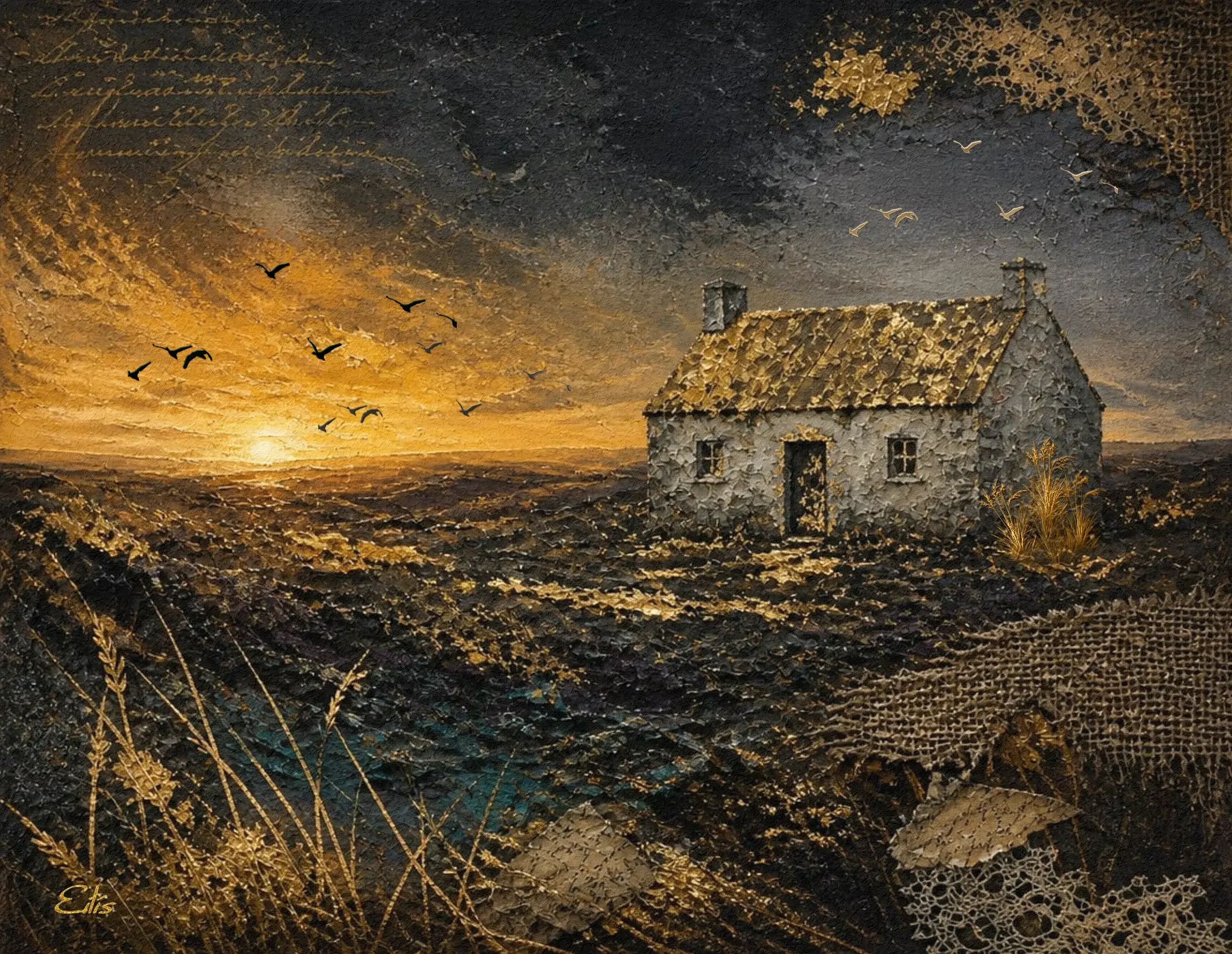
I began with the sky. I always begin with the sky in these western landscapes, because the sky in Connacht is where everything happens first. It is enormous and mobile, and it carries the emotional weather of a place that has always expressed its inner life outward, into the atmosphere. I built the amber and the ochre in layers, working them into the surface until the light felt earned — the specific, almost desperate quality of the sun in its last twenty minutes, burning with a generosity that knows it is almost spent. The dark charcoal pressing in from the upper right came later, cloud-mass and inevitability, the night gathering its patience. But that tension — between the warmth that is leaving and the cold that is arriving — is the exact tension at the heart of Yeats's play, and I wanted to hold it without resolving it.
The cottage placed itself. I have painted many such cottages — they are part of the visual grammar of the place — but this one I painted slowly, carefully, with a particular awareness of what it means in the Irish imagination. It is not merely a building. For generations, it was the site of everything: birth and death, storytelling and silence, the keeping of the old ways. In the play, the entire drama unfolds inside such a cottage, yet the real pull comes from outside it. The fairy child stands at the door. The field and the fading light are on the other side. Mary Bruin looks toward the open door, and something in her, some part of her that the domestic life has not managed to fully contain, answers.
I gave the roof of the cottage gold. Real gold, worked into the impasto, catching the light differently as you move around the painting. I did this because I have seen thatched roofs hold the last of the evening sun in exactly this way — not reflecting it so much as absorbing it, keeping a little of the warmth back as the day withdraws — and because the gold threads running through the work as a whole were my way of saying what I believe about this landscape: that it is genuinely precious, that the beauty of it is material and specific and not a projection.
What strikes most, looking at the foreground, is its paradoxical richness. The bog — that ancient, dreaming substance that has swallowed and preserved so much of Irish history, that has kept bodies and butter and bronze-age offerings perfectly intact for thousands of years, as though the land itself refuses to let go of what it loves — is rendered here with threads of real gold running through the dark earth. This is not fanciful decoration. The bogland of Connacht genuinely glitters in certain lights, in certain weathers; the standing water catches the sky, the sedge and the cotton grass and the bog asphodel hold the last warmth of afternoon, and the result is something that looks like buried treasure, like all the accumulated grief and beauty of the place working its way back to the surface. The teal glints in the lower middle ground — barely visible, easy to miss — are like those sudden unexpected moments of piercing loveliness that ambush you on an ordinary day in an extraordinary place.
The birds were the last major element to arrive, and they arrived all at once, quickly, in a state of certainty I have learned to trust. In Celtic tradition, birds carry the souls of the dead. They carry messages between worlds. They are the embodied form of the thing that calls to you from beyond the visible. I placed them wheeling toward the low sun, loose and free in their formation, going where the living cannot easily follow, and painting them, I felt something shift in the work — a kind of animate quality entering it, the suggestion of movement and departure that the rest of the composition holds very still.
The hessian and the lace were the most personal elements, and the most difficult to integrate. Hessian is the fabric of practicality and labour — it carries harvest in it, the weight of necessary things. Lace is its opposite and its companion: delicate, painstaking, the product of patient hands in difficult circumstances, made in the west of Ireland for centuries by women who needed the income and who put extraordinary beauty into work that most of the world never saw. Laying these materials into the surface together felt like an act of witness — to the double nature of life in this part of the country, the roughness and the beauty inseparable, the hard and the tender always occurring in the same breath.
The old handwriting ghosting through the upper left came from the ledger pages. I chose not to make it legible. I wanted it to have the quality of something half-remembered — a letter that was never sent, or a poem that existed for a while and then was lost, or the names of people who lived in such cottages and whose lives the land still carries in its peat and its stones. Yeats believed the land was a living repository of memory, that the stories and the griefs of the dead did not simply disappear but settled into the landscape and waited there. Standing at the edge of the bog on any given evening, it is very easy to believe the same thing.
I signed my name in the lower left in gold, small, the way I always sign these landscapes — a simple confirmation of presence. I was here. I felt this particular falling of light over this particular ground, and I tried to hold it in such a way that you could feel it too, standing in front of the canvas, even if you have never stood on a Connacht bog in your life, even if the west of Ireland is a country you know only through words and music and the kind of inherited longing that the Irish diaspora knows so well.
Yeats's Mary Bruin reaches the land of her heart's desire and is destroyed by it, because the otherworld has no place for a living body, only for the reaching itself. I have thought about this for a long time. I think what he was saying — what he perhaps could not have said in any other form — is that the desire is the point. The reaching is the point. The land of heart's desire is not a destination. It is the name we give to the particular quality of longing that the beautiful and the passing and the almost-beyond-reach call out of us when we are standing in the right light at the right moment, paying attention.
I painted this because I have stood in that light many times, and I needed somewhere to put what it does to me.
This is where I put it.