Fillette en Bleu
The Girl in the Blue Dress
The painting had always occupied that particular wall—the one directly opposite the bed in the sea house, where salt air crept through window frames and settled on surfaces like a second skin. Amedeo Modigliani's fillette emerged from her canvas with that characteristic stillness the Livornese painter had perfected: a deliberate suspension between presence and absence, the figure rendered in elongated lines that suggested both fragility and an uncanny permanence.
Experts spoke of its essential quality, the way the child materialised from a neutral, undefined background as though conjured from fog. They praised the peculiar luminescence that seemed to emanate from within the painted girl herself—not reflected light but something intrinsic, making her almost metaphysical, spectral. The portrait captured a single arrested moment: the instant before emerging fully into life, shadowed by the death that perpetually loomed at the edges of consciousness. Meticulously observed yet strangely distant, it explored an existential dimension that remained fundamentally unknowable.
The woman who would later remember this painting had been, at seven or eight, roughly the same age as the subject. Each night before sleep claimed her, she lay propped against pillows, her own small frame mirroring the painted child's slightness, and gazed into those impossibly azure eyes. They were the colour of deep water on windless days—cerulean, fathomless, holding light in a way that suggested interiority rather than surface. In that nightly ritual of looking, she lost herself in the mirror of another child's inner world.
Their conversations were wordless but complete. The girl in the bed and the girl on the wall discussed the small, tremendous things that constituted a child's universe: the precise shade of a dress, the way fabric fell or gathered, the sensation of being seen and simultaneously invisible. That particular blue—"cielo", sky-coloured—imprinted itself on her developing sensibility so thoroughly that it became the chromatic constant of her life. Decades later, she would still choose it instinctively: in cardigans and curtains, in the paint on her walls, in the objects that accumulated around her like sediment.
But the painted child's eyes held more than beauty. They carried sadness like a physical weight, a shy reticence that spoke of withholding rather than offering. The watching girl, secure in her mother's love, nevertheless sensed abandonment in that frozen face. She couldn't have articulated it then—this intuition that the fillette was unloved, perhaps orphaned, someone who no longer knew maternal tenderness or care. The feeling settled in her chest, a small ache of pity mixed with the strange guilt of the fortunate.
That sadness persisted, sedimentary, through the accumulated years. It surfaced decades later in the small hours when, at seventy, she turned restlessly in her bed, her body stiff in ways that reminded her of time's passage. Her mother had been gone for years—so many that grief had transformed into something quieter, a background hum rather than acute pain. Yet in sleeplessness, in the shadows that gathered against the ceiling, she sometimes felt the ghost of those maternal caresses: the particular weight of a hand smoothing hair, the warmth that meant safety. A life largely lived now, most of it trailing behind her like a wake.
The reproduction itself had vanished somewhere in the succession of house moves that punctuated adult existence—those periodic uprootings that scattered possessions and severed connections to earlier selves. She'd never learned the real girl's identity, never discovered her name or traced the trajectory of her brief or long life. The model remained anonymous, as Modigliani's subjects often did, known only through the painter's transformative gaze.
Still, the memory persisted with surprising clarity. The woman found herself thinking of her childhood companion often: those sea-coloured eyes, that suspended moment of nightly communion. The fillette had kept vigil through countless evenings, a silent witness to the small dramas and discoveries of girlhood.
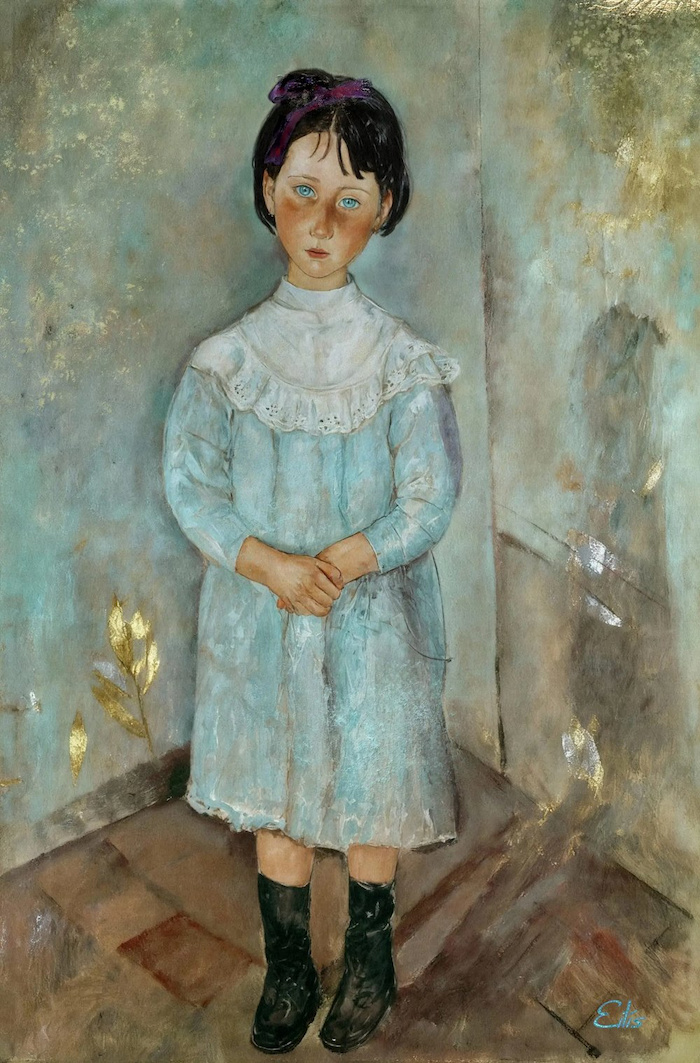
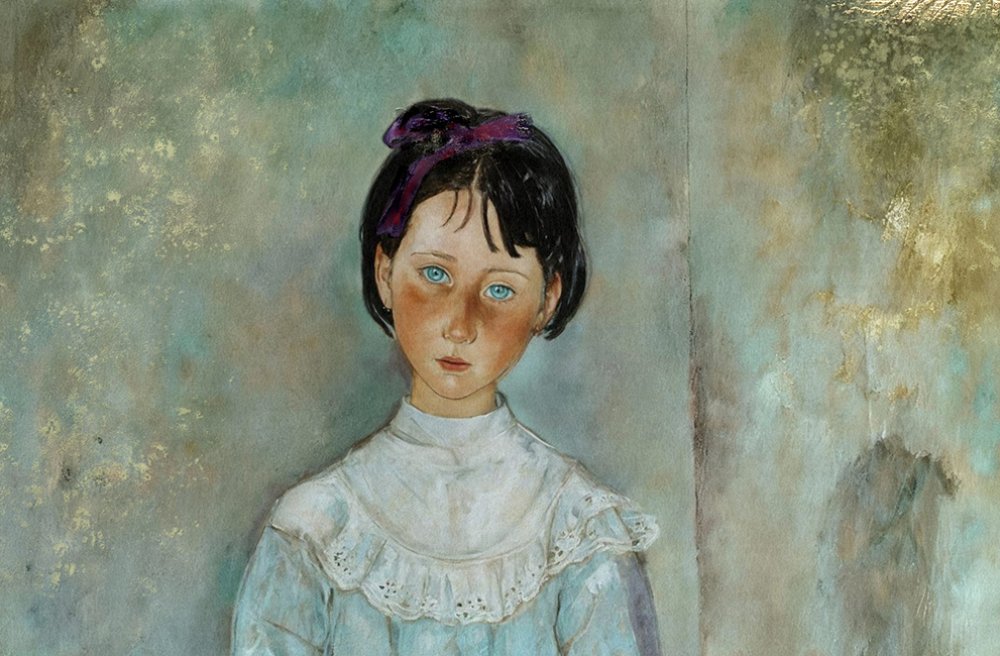
When she finally decided to recreate that lost companion, her hands moved with the muscle memory of longing. She painted her own version of Modigliani's fillette on canvas, following the remembered contours of that elongated neck, the tilt of the head, the particular quality of those azure eyes that had once gazed back at her across the dim space of a childhood bedroom. Her brushstrokes sought to capture not merely the image but the presence—that peculiar luminescence, the suspended quality of a life caught between emergence and erasure.
But she added something Modigliani had not. Into the deliberately neutral background, she worked touches of gold leaf and gilt paint—small accretions of light that caught and held brightness. The gold settled around the fillette like a benediction, like hope made tangible. It was an intervention, a refusal of the original's existential bleakness. Her brush moved slowly, carefully, as she built up these luminous fragments, each one a silent prayer that the real child—whoever she had been—had known moments of happiness, however fleeting.
The tribute formed itself silently through these accumulated brushstrokes, addressed to an unknown girl across decades. Her shoulders ached from the sustained posture of painting, her fingers cramped around the brush, but she continued until the last gold accent settled into place. The canvas before her held both memory and revision: Modigliani's melancholy vision transformed by her own insistent additions of light.
Thank you, my little friend, she thought, stepping back to regard the completed work. This is for you—for your sincere eyes, for your sky-blue dress.I've added gold to the background in my imagination, hoping your existential sadness held at least brief moments of happiness, of hope, of love.
The gold caught the afternoon light slanting through her studio window, creating small aureoles of brightness that shifted as she moved. It was both homage and correction, an acknowledgement that some sadnesses were constitutional, woven into being, yet also a stubborn assertion that even existential loneliness might be penetrated by grace. The girl in the blue dress gazed out from the canvas with those same fathomless eyes, but now surrounded by intimations of warmth, by the possibility—however remote—that darkness could be interrupted by brightness.
The sea house was long gone, sold or demolished. The original reproduction lost to time's casual dispersals. But here, recreated by her own hand and transformed by her intervention, the image persisted. Those azure eyes still gazed from their eternal present, but now held also the retrospective gift of gold—light added not by Modigliani's hand but by hers, a bridge spanning seventy years and the unbridgeable distance between viewer and viewed, between the child she had been and the woman she had become.